
All-on-4 in Chêne-Bougeries
Understand fixed full-arch restoration on implants, its requirements, alternatives and follow-up before making a decision.
Book an assessment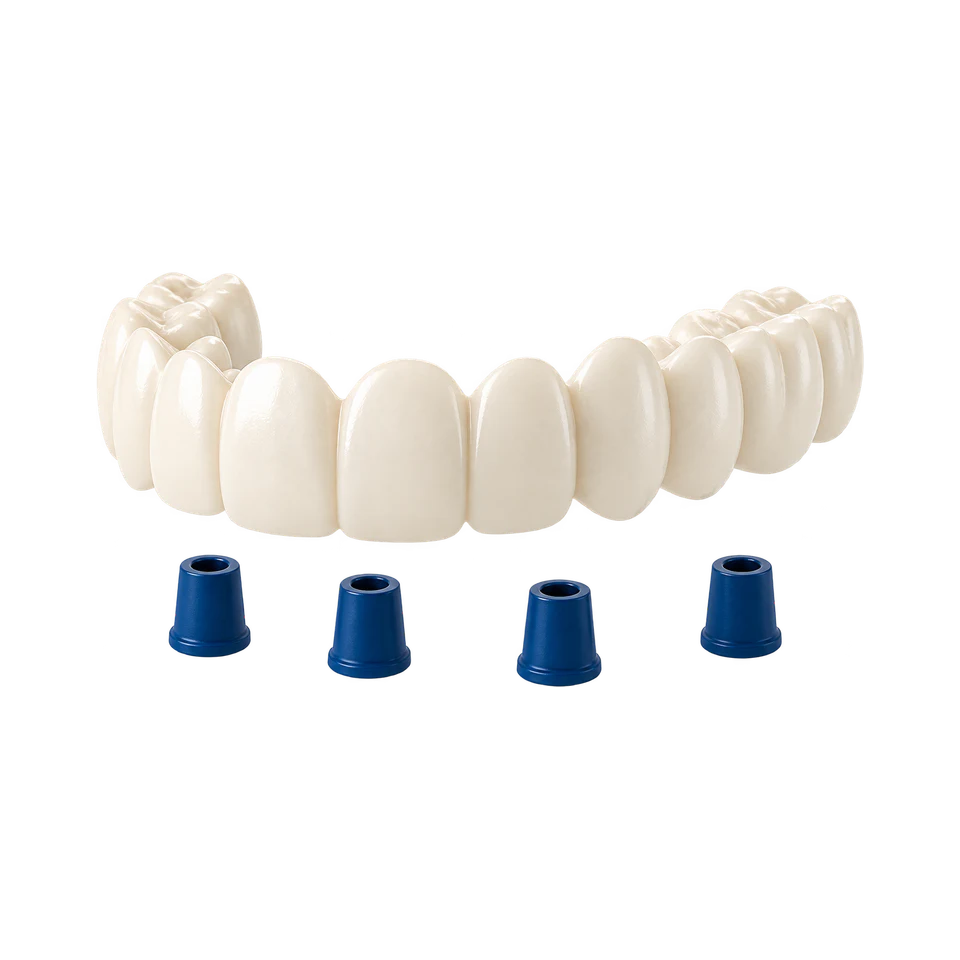
This information is general. It cannot determine whether All-on-4 is suitable for you and does not replace an examination, diagnosis or personalised quotation.
Reviewed by Fabio Cunha, .
Key points
- All-on-4 refers to a fixed full-arch restoration supported by four implants positioned according to a precise surgical and prosthetic plan.
- The number and position of the implants, and whether the restoration can be used soon after surgery, depend on the individual assessment.
- Preserving existing teeth and considering other fixed or removable solutions are part of the discussion before any decision.
- Daily hygiene, check-ups and maintenance of the restoration remain essential over the long term.
A fixed restoration for a complete dental arch
All-on-4 is a treatment concept designed to support a complete fixed restoration on four implants that are appropriately distributed across one arch.
The term applies to one upper or lower arch. It does not mean that four implants are automatically sufficient for the whole mouth, or that this plan is suitable for everyone.
Depending on the anatomy and prosthetic plan, some posterior implants may be angled. Their distribution must take into account the available bone, the space required for the restoration, the bite and access for cleaning.
This approach does not replace a single tooth. It addresses a different situation: restoring an entire arch when a complete solution needs to be considered.
Planning starts with the existing teeth and the future restoration
The assessment first considers what can be preserved, then compares the options for the arch as a whole.
A photograph, form or remote description cannot establish whether the treatment is indicated. The number of implants and type of restoration are chosen following a clinical and prosthetic assessment.
- Your health, medicines, current treatments and factors that may affect surgery or healing.
- The condition and prognosis of existing teeth, gums and the tissues around any existing implants.
- Bone volume and quality, the anatomy of the arch and any radiographic examinations considered necessary.
- Available space, lip support, smile line, the opposing arch and the future distribution of forces.
- Your expectations and priorities, and your ability to clean beneath the future restoration.
All-on-4 is one option among several
When teeth are still present, the possibility of preserving them should be assessed before considering a complete full-arch restoration.
Depending on the situation, the options may include treatment intended to preserve some teeth, another fixed implant restoration, an implant-retained removable denture or a conventional complete denture.
Each option involves a different balance of surgery, stability, maintenance, repairability, cost and personal preference. Using the fewest possible implants is not a goal in itself: the plan must remain consistent with the future restoration and the possible consequences of a complication.
A coordinated surgical and prosthetic pathway
The sequence, number of appointments and timetable vary. An immediate fixed provisional restoration is only possible when the clinical conditions and implant stability allow it.
1. Assessment and comparison of options
Clinical examination, medical history, additional investigations and discussion of possible solutions, including preserving teeth when this can be considered.
2. Prosthetic planning
Definition of the future restoration, the space required, the desired appearance, access for hygiene and the planned implant distribution.
3. Surgical planning and quotation
Explanation of the proposed procedures, alternatives, risks, loading protocol and estimated cost before you decide.
4. Surgical stage
Placement of the implants according to the agreed plan. Extractions or an additional procedure are only carried out if they form part of the treatment you have accepted.
5. Provisional restoration according to the conditions
A provisional restoration may be fitted immediately, later, or replaced by a different temporary solution. The decision depends in particular on the stability achieved and the clinical context.
6. Reviews and final restoration
Follow-up appointments monitor healing and function. The final restoration is made according to the timetable established for your situation.
A fixed solution with its own constraints
The aim is to restore an arch with a restoration that the patient does not remove. No result, timeframe or lifespan can be guaranteed.
Surgical and biological risks may include infection, healing problems, failure of an implant to integrate or loss of an implant, effects on nearby tissues and inflammation around the implants. Your individual risk depends on your health, oral condition and other personal factors.
Technical complications may also affect the screws, components or restoration and require adjustment, repair or replacement. With four implants, the loss of one may alter support for the restoration as a whole.
A complete fixed restoration needs sufficient access for cleaning. The ability to maintain the area and attend follow-up appointments is part of the discussion before treatment.
The quotation depends on the complete treatment plan
A reliable fee can only be established after the assessment. The quotation covers the surgical and prosthetic stages actually planned.
The cost may vary according to the investigations required, extractions or preliminary treatment, number of implants, any additional procedure, the temporary restoration and the final restoration. The practice provides a personalised quotation before treatment.
In Switzerland, dental care is generally not covered by compulsory health insurance. Exceptions apply in specifically defined situations. Any supplementary cover depends on your policy.
View fees and payment informationFollow-up covers the implants, tissues and restoration
The restoration remains fixed for the patient, but it must be cleaned every day and professionally reviewed at intervals tailored to the individual.
Cleaning must reach beneath the restoration and around each implant. The instruments and method are adapted to the shape of the restoration and your dexterity.
Follow-up appointments check the tissues, hygiene, function and condition of the prosthetic components. Frequency depends in particular on periodontal history, smoking, hygiene and clinical findings.
Contact the practice if you notice mobility, unusual pain, bleeding, swelling or a change in the restoration. A general information page cannot identify the cause.
Explore dental hygiene careFrequently asked questions about All-on-4
Does All-on-4 always mean exactly four implants?
The concept uses four appropriately distributed implants to support a complete fixed restoration in one piece. The assessment may nevertheless lead to a different number of implants or another type of restoration when the anatomy, planned restoration or consequences of a possible complication justify it.
Can everyone leave with fixed teeth on the same day?
No. Immediate loading depends in particular on the stability achieved for the implants, the bone, the prosthetic plan and any additional procedures. The protocol and temporary solution are decided for each situation.
Do all existing teeth have to be removed?
Not automatically. The prognosis of each tooth and the possibilities for preserving it must be assessed. Extraction is only considered as part of a plan that has been explained and accepted.
How is this different from a complete removable denture?
The All-on-4 restoration is fixed to the implants and is not removed every day by the patient. A conventional complete denture is removable. Other removable solutions can also be stabilised by implants; the choice depends on the assessment and the priorities discussed.
How long does the treatment take?
The timetable depends on preliminary care, surgery, healing, the loading protocol and fabrication of the restoration. No universal timeframe can be given before the assessment.
How much does All-on-4 treatment cost?
The cost depends on the complete plan and cannot be reduced to the number of implants. Investigations, surgical procedures and the provisional and final restorations are set out in a personalised quotation after the assessment.
How do I care for an All-on-4 restoration?
Daily cleaning around the implants and beneath the restoration is necessary, using suitable instruments. Professional reviews also monitor the tissues, function and components of the restoration.
General medical sources
These sources support the general information. Only a clinical assessment can establish which options are appropriate for you.
- International Team for Implantology: Number of implants for complete-arch fixed prostheses
- International Team for Implantology: Loading protocols for fixed prostheses in edentulous jaws
- SSO: Quality guidelines for oral surgery and implantology
- European Federation of Periodontology: Prevention of peri-implant diseases
- Federal Office of Public Health: Dental care and compulsory health insurance
- PubMed: 2025 overview of systematic reviews on the All-on-Four treatment concept
Sources consulted on 8 September 2026.
Let’s get acquainted.
Choose an appointment online or contact reception.
Discussing
All-on-4
Have a question about this care? The practice welcomes you in Chêne-Bougeries, by appointment.
Contact and directionsVisiting the practice
Parking is available at the practice. Call reception at the barrier to access the car park.
Get directions